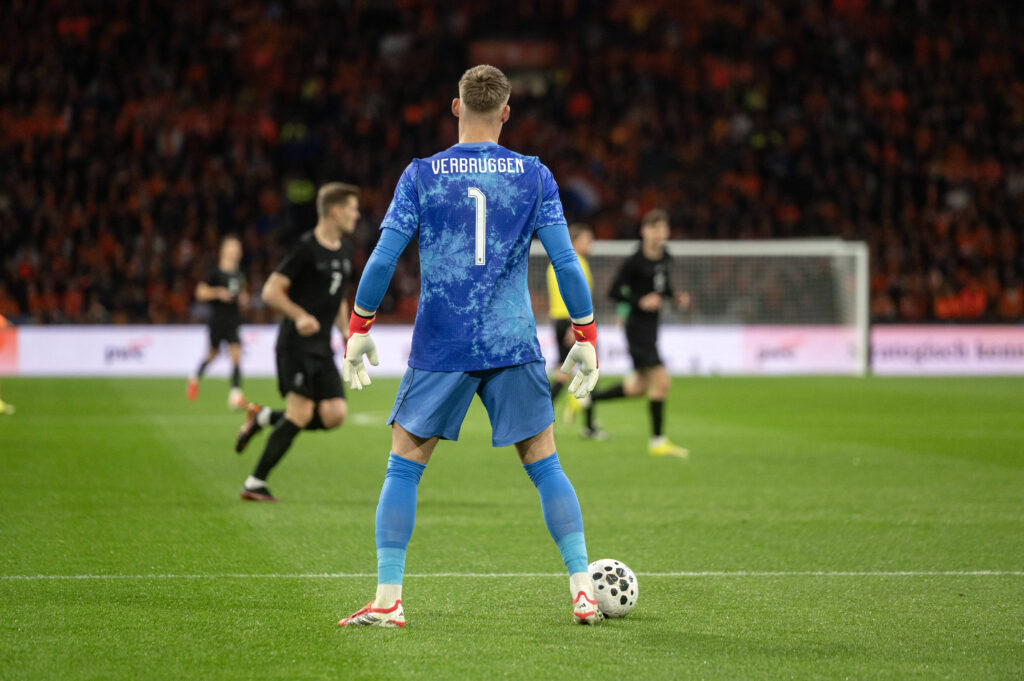
Bart Verbruggen is not getting the clean-sheet headlines that usually define a goalkeeper’s tournament. That is exactly why his Netherlands group stage should matter to Brighton.
Ronald Koeman’s side have moved into the last 32 after beating Tunisia 3-1 and winning Group F, with The Guardian reporting that the result secured top spot ahead of Japan. Verbruggen conceded again, but RotoWire’s match data credited him with three saves on the night, taking him to 11 saves and four goals conceded across the group.
For Albion, the bigger message is not simply that their No.1 is still in the World Cup. It is that he is being tested in the precise environment that exposes whether a modern goalkeeper can hold value at the elite end of the market.
Verbruggen Is Building A Different Case
The 5-1 win over Sweden looked like a Dutch attacking parade on the scoreboard, yet Verbruggen’s workload told a sharper story. He made seven saves in that game, including key first-half interventions as Sweden generated eight shots on target.
That performance sat neatly alongside the broader Brighton question raised earlier in the tournament, when Verbruggen’s World Cup ambition looked like a major chance to strengthen his standing. The Tunisia win has now moved that argument from projection to evidence.
- Group finish: Netherlands top of Group F
- Verbruggen output: 11 saves in three matches
- Next test: Morocco in the round of 32
- Brighton context: contract runs to 2028, according to Transfermarkt
Why This Matters For Brighton’s Contract Planning
Brighton have become comfortable selling from strength, but goalkeeper value behaves differently from outfield-player value. The market is narrower, elite clubs are selective, and one strong international tournament can rapidly shift how a young No.1 is viewed.
Verbruggen is 23, already established at Premier League level, and playing tournament football behind a Netherlands side that can dominate possession without fully protecting him. That is a useful valuation cocktail. He is not being carried by a passive defensive block. He is being asked to stay alert, restart attacks cleanly, and make saves after long periods without rhythm.
That profile is exactly why Brighton should treat this knockout run as a contract-management prompt. A deal running to 2028 gives the club control, not comfort. By next summer, the pressure point becomes obvious: either reinforce his long-term status with improved terms or accept that the market will begin pricing him as an obtainable goalkeeper entering the final two years of his agreement.
Hurzeler Gets A Pre-Season Bonus
There is also a football benefit for Fabian Hurzeler. Brighton’s European season will demand a goalkeeper comfortable with higher-stakes swings, quick restarts and long spells of concentration. The World Cup is sharpening those habits without Albion having to manufacture the intensity in July friendlies.
The risk is workload. If the Netherlands go deep, Verbruggen’s summer break shrinks and Brighton’s pre-season rhythm becomes more complicated. Yet the upside is clear: Albion’s first-choice goalkeeper is getting knockout-stage education before a campaign in which small margins will define league and European progress.
It also strengthens the internal hierarchy. Brighton have previously had to manage the Jason Steele-Verbruggen debate, and that kind of rotation becomes harder to justify when one goalkeeper is collecting pressure minutes for a major nation. Hurzeler does not need to declare a public shift, but the evidence is moving in one direction.
The cleaner Brighton are about that status, the easier their summer planning becomes. A settled No.1 changes recruitment around the back line, reduces the need for a contingency keeper, and allows the club to focus resources on the defensive rebuild already taking shape elsewhere in the squad.
For Brighton, the message is simple. Verbruggen’s World Cup is no longer just a nice international subplot. It is becoming a contract, valuation and succession-planning reminder wrapped into one tournament.








Comments.
Loading comments…