
At a glance
- Brighton Women’s story began with GPO telephonists in the late 1960s
- The club battled bans, poor facilities and years outside the spotlight
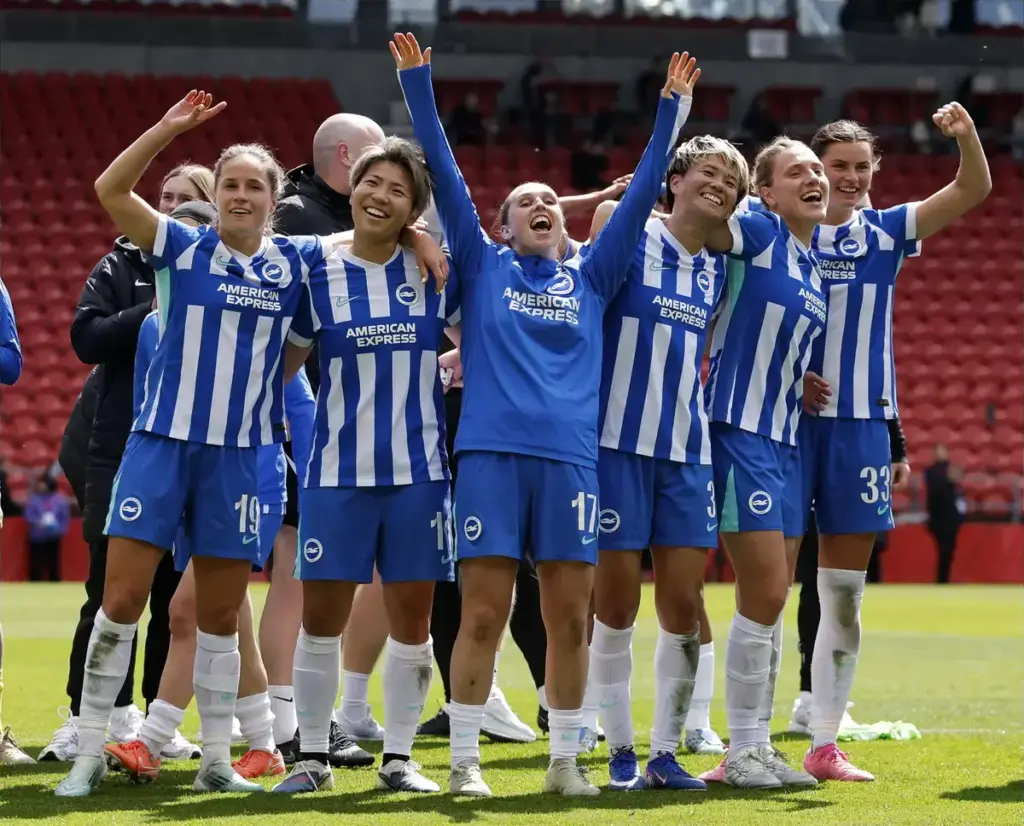
- Wembley now awaits after Brighton’s greatest-ever Women’s FA Cup run
Long before Wembley finals, sold-out crowds and Women’s Super League ambitions, Brighton & Hove Albion Women began life with a group of determined telephonists playing charity football matches in Sussex.
The roots of Brighton Women stretch back to the late 1960s following England’s 1966 World Cup triumph when growing interest in football inspired women in Brighton to form their own side through the social club at the Brighton General Post Office.
At a time when women’s football remained banned by the Football Association, opportunities were scarce and conditions were far from glamorous. Yet from those difficult beginnings emerged a football club now preparing to walk out at Wembley in a Women’s FA Cup final.
Brighton women started against the odds
The earliest Brighton women’s teams operated under severe restrictions.
Women were banned from playing on FA-affiliated pitches and could not use official referees. Matches were played with size-four footballs while games were shortened to 35-minute halves.
Home fixtures often took place on public parks and recreation grounds including Buckingham Park and Waterhall because women’s teams were not permitted access to many established football facilities.
Changing rooms were frequently unavailable and even when facilities existed, women’s sides were often denied access.
Despite those barriers, women’s football in Sussex continued to grow rapidly.
By 1969 there were enough clubs to establish the Sussex Martlet League and the Albion Supporters’ Club soon formed its own side known as Albion Ladies.
Albion Ladies enjoyed early success
Albion Ladies entered the Sussex Martlet League in 1971 and quickly established themselves as one of the strongest teams in the region.
The side won multiple league titles and reached the semi-final of the Women’s FA Cup in 1976 before eventually disbanding later that decade.
Among the key figures behind the team’s formation were lifelong Brighton supporters Christine Read alongside Jean and Alf Walker.
The club’s growth mirrored the wider expansion of women’s football across Sussex as more teams and competitions began to emerge.
Read more: Fabian Hurzeler reveals standards driving Brighton’s European push
C&C Sports helped build Brighton’s foundations
By the late 1970s the Brighton women’s setup evolved again after receiving sponsorship from local sports retailer Clapshaw & Cleave.
Operating as C&C Sports, the team dominated local football during the 1979-80 campaign by winning the Sussex Martlet League title, League Cup and Division One Cup.
That success prompted a move into the stronger Home Counties League where the club continued progressing despite increased travelling demands.
Southwick FC and East Preston both became important homes during this era as the club searched for facilities capable of supporting growing interest in the women’s game.
Brighton officially affiliated in 1990
A major turning point arrived in 1990 when C&C Sports officially affiliated with Brighton & Hove Albion through Albion’s Football in the Community programme.
The team became Brighton & Hove Albion Women & Girls FC and initially played at Sussex University before later moving to Withdean Stadium.
At the same time the club joined the new South East Counties Women’s League before progressing into the Women’s FA National League Division One South.
Former player Julie Hemsley became one of the leading figures behind the development of women’s football at Brighton and nationally.
Julie Hemsley helped shape Brighton Women’s future
Hemsley combined coaching responsibilities at Brighton with development work through the FA and later became the first woman appointed to the FA Council with responsibility for women’s and girls’ football.
She also worked alongside future Brighton and England manager Hope Powell during her time with the national setup.
Under her influence Brighton’s women’s structure expanded rapidly with multiple age-group teams and a centre of excellence established during the mid-1990s.
The club also began producing players who represented England at various youth levels while Sophie Perry earned senior international recognition with the Republic of Ireland.
Brighton Women climbed towards the elite
Brighton continued progressing through the women’s football pyramid during the 1990s and early 2000s.
The club won the inaugural Sussex Women’s Cup in 1995 and later spent two seasons competing in the top flight before dropping back into the second and third tiers.
Even during difficult periods, interest in women’s football across Sussex continued to grow strongly through Brighton’s community programmes and development work.
The modern breakthrough arrived in 2016 when Brighton secured promotion to WSL 2 following a dramatic 4-2 play-off victory over Sporting Club Albion.
Hope Powell and professional football changed everything
Following restructuring within the women’s game, Brighton appointed former England manager Hope Powell in September 2017.
Under Powell’s leadership Brighton earned promotion into the fully-professional Women’s Super League structure after successfully securing a top-tier licence from the FA.
The club moved to Broadfield Stadium and steadily established itself within the top division of English women’s football.
Subsequent managerial spells under Jens Scheuer, Melissa Phillips and Mikey Harris eventually led to the appointment of Australian coach Dario Vidosic.
Also read: Leeds vs Brighton: The last five meetings
Wembley represents Brighton Women’s greatest chapter yet
Under Vidosic, Brighton have taken another major leap forward.
The arrivals of experienced England internationals Fran Kirby and Nikita Parris strengthened an already talented squad while the club achieved its highest-ever Women’s Super League finish by ending the 2024-25 season in fifth place.
Now Brighton Women stand on the brink of the biggest day in their history as they prepare for a first-ever Women’s FA Cup final at Wembley.
For a club that began with telephonists organising charity matches during an FA ban on women’s football, the journey to English football’s grandest stage is extraordinary.
And if Brighton complete the story with silverware at Wembley, it would become one of the greatest moments the football club has ever known.
Follow all the latest Brighton & Hove Albion news through Read Brighton.



Comments.
Loading comments…