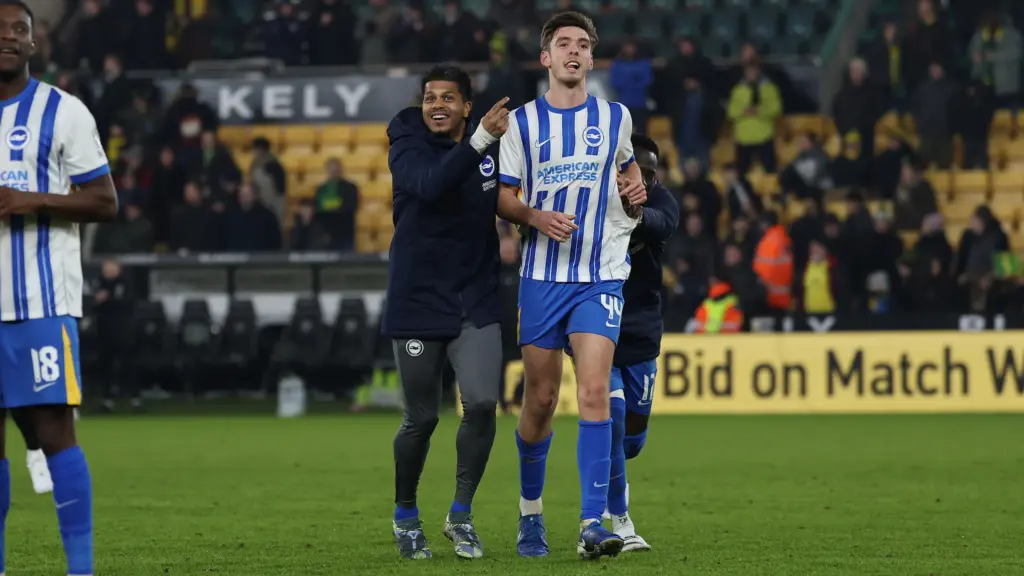

Ruairi McConville becoming a £20m discussion point at Norwich City should not be filed as a simple Brighton regret story. The issue is sharper than that.
It asks whether Albion’s academy-trading model is leaving enough room for late-developing defenders to turn pathway promise into first-team value at the Amex.
WeAreBrighton highlighted the debate on 5 July, citing Kevin Phillips’ view that McConville could attract Premier League interest around the £20m mark if he sustains his Norwich form.
That is a striking projection for a player Brighton allowed to leave for undisclosed terms in February 2025, only weeks after his senior debut in the FA Cup win at Carrow Road.
Brighton’s own announcement framed the decision cleanly. Technical director David Weir said McConville wanted regular senior football, with Norwich’s offer viewed as a good one for both club and player.
That remains the rational defence. McConville needed starts. Brighton could not guarantee them.
The uncomfortable part is what happened next.
The Price Of Senior Minutes
McConville has become a useful case study because centre-backs do not always mature on academy timelines.
Physical duels, defensive leadership and decision-making under pressure often need senior football rather than controlled under-21 exposure. That is why his Norwich progress feels worth revisiting rather than dismissing as hindsight noise.
The Irish FA reported at the time that McConville’s move was believed to be worth around £1.25m, rising beyond double that figure with add-ons. If the new £20m conversation is even close to realistic, the value jump is not marginal.
It is the sort of acceleration Brighton usually try to own, not watch from a distance.
That does not automatically make the sale reckless. Brighton’s academy cannot keep every prospect indefinitely, and the club have built a strong reputation by being decisive before sentiment clouds judgement.
McConville’s profile was not ordinary, though. He had captained Brighton’s under-21s, earned senior Northern Ireland recognition and carried the frame of a modern Premier League centre-back. Those markers explain why the deal now feels like one for the recruitment department to review.
Cashin Context Makes The Call Harder
The debate bites because Brighton were also investing in the same part of the pitch.
Eiran Cashin’s arrival gave Albion another left-sided defensive option, and ReadBrighton has already looked at how Cashin’s Blackburn resurgence could force a summer rethink.
When a club sells one young defender and buys another, comparisons are inevitable. They are not always fair, but they are unavoidable.
Cashin was closer to the first-team picture in age and domestic experience. McConville offered the longer runway, the academy connection and the potential resale curve.
Fabian Hurzeler’s squad planning adds another layer. Brighton were entering a cycle where defensive depth was becoming more valuable, with European football, transfer churn and the need to refresh the back line all pulling in the same direction.
ReadBrighton has since covered how Pascal Struijk’s arrival fits Albion’s defensive reset, while the club’s move for Luka Vuskovic has created another major centre-back trade-off.
That context makes McConville’s rise more than a footnote. Brighton have clearly identified centre-back as a priority zone. One of their own former prospects is now being discussed in the same market language.
Brighton Cannot Treat Every Exit As A Mistake
There is a danger in judging academy sales only through hindsight.
Had Brighton kept McConville and left him short of minutes for another season, the criticism would have moved in the opposite direction. The club would have been accused of slowing his development and protecting an asset without giving him a pathway.
The smarter conclusion is narrower. Brighton may need to be more aggressive with structured exits for academy players who have senior international traction, strong physical profiles or clear late-development potential.
That means heavier sell-on clauses, buy-back mechanisms or loan-to-buy arrangements where possible. For a club whose recruitment edge depends on controlling future upside, those details can be as important as the headline fee.
McConville’s progress at Norwich should not embarrass Brighton. It should sharpen them.
The next defender in that bracket may be worth less as an immediate squad member than as an asset Albion cannot afford to underprice.
That is the real lesson for Brighton: keep selling boldly, but make sure the contract architecture protects the upside when the talent evaluation is already pointing in the right direction.



Comments.
Loading comments…