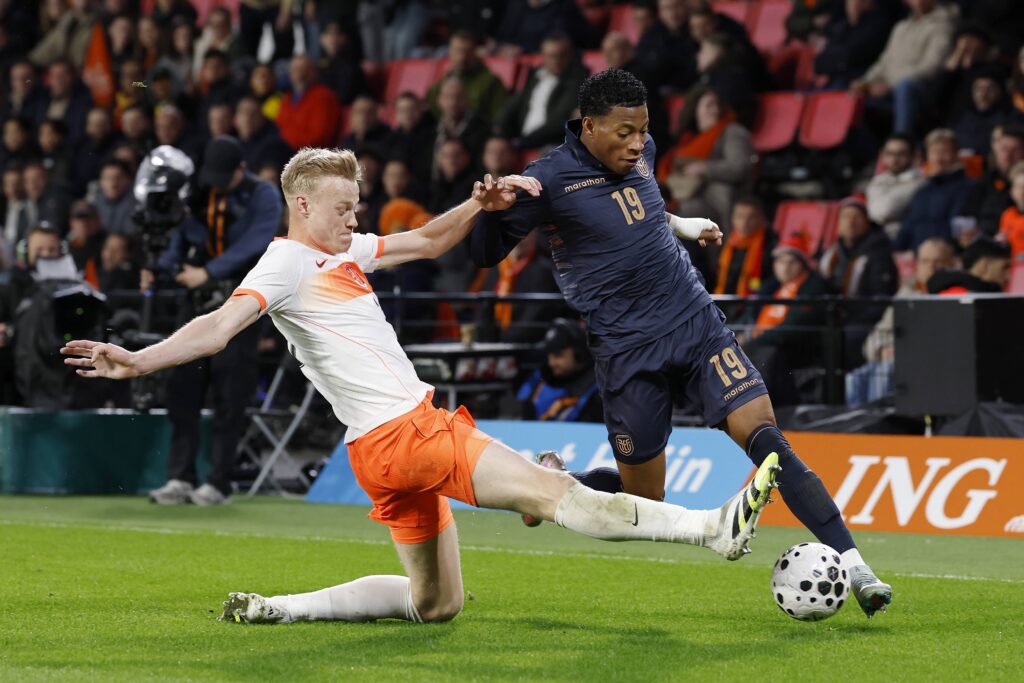

Jan Paul van Hecke has left Brighton & Hove Albion for Tottenham Hotspur with his reputation enhanced and his development story complete.
The Jan Paul van Hecke Brighton journey ended with a permanent transfer to Spurs, but it should not be reduced to another painful Premier League sale. It is also one of the clearest examples of what Albion do best: spot talent early, develop it carefully and turn patience into elite-level value.
Brighton confirmed his departure after six years at the club, with Van Hecke leaving after 131 appearances and four goals. He arrived from NAC Breda in 2020 as a promising young defender and leaves as an established Premier League centre-back and Netherlands international.
That is why this one hits differently.
Brighton supporters will feel the loss because Van Hecke became central to the side. He was aggressive, brave on the ball and easy to connect with because his commitment always felt visible.
But Brighton can also point to his rise as a genuine development win. They did not just buy a finished player. They built one.
Van Hecke’s Brighton Pathway Actually Worked
Brighton talk a lot about pathway, and with good reason. Van Hecke is one of the best recent examples of that idea becoming reality rather than recruitment language.
He did not walk straight into the first team after signing from NAC Breda. Instead, Albion mapped out a route that gave him time to grow without forcing the process.
His loan to Heerenveen offered regular senior football in familiar surroundings. His spell at Blackburn Rovers then toughened him in English football and helped shape the combative edge Brighton fans came to admire.
By the time he returned to Brighton properly, he looked like a defender who had been tested rather than protected.
That matters. Not every young signing needs the same route, and not every prospect develops in a straight line. Some need minutes. Some need setbacks. Some need a league that demands more contact, quicker decisions and different pressure.
Van Hecke had all of that before he became a Brighton regular.
ReadBrighton has already looked at how the Van Hecke exit gives Albion a familiar Tottenham test, but this story is bigger than Tottenham. It is about the mechanics of Brighton’s model.
Good clubs do not simply buy well. They sequence careers well too.
De Zerbi Turned Potential Into Premier League Authority
If Van Hecke’s early Brighton years were about development, the Roberto De Zerbi period was about acceleration.
Centre-backs in De Zerbi’s Brighton side had to do more than defend the box. They had to invite pressure, split lines, step forward and stay calm when the game became chaotic.
Van Hecke suited that challenge.
He had the physical courage to defend high, but also the personality to take responsibility in possession. That combination made him more than a reliable defender. It made him part of Brighton’s identity.
Tottenham’s official announcement captured that neatly, with De Zerbi describing him as a strong, intelligent centre-back who is brave in possession and plays with personality.
That description lands because it reflects what Brighton supporters saw.
Van Hecke did not just survive in a demanding build-up system. He became one of the reasons it functioned.
The 2023/24 campaign was especially important. Tottenham noted he made 39 appearances across all competitions that season, including seven in the UEFA Europa League.
For Brighton, that season asked new questions. European nights, Premier League recovery, tactical stress and bigger-stage pressure all arrived together.
Van Hecke handled enough of it to move from useful option to genuine first-team presence.
Dunk Partnership Gave Brighton A Proper Defensive Base
Van Hecke’s development also owes something to the player alongside him.
His partnership with Lewis Dunk gave Brighton balance. Dunk brought authority, organisation and passing range. Van Hecke added bite, front-foot defending and recovery power.
That pairing helped Albion defend proactive spaces without losing their build-up courage.
Once a young defender becomes trusted next to the club captain, the conversation changes. Van Hecke was no longer a player who might become important. He already was.
Brighton’s own 100-appearance analysis showed the scale of his influence. On his centurion match against Newcastle United, he led Albion for touches, passes and progressive passes, while also producing the most clearances and blocked shots among Brighton players.
That is the modern centre-back portfolio in one game.
He was not just moving the ball. He was defending the penalty area, winning duels and helping Albion progress play from the back.
This is why his departure creates such a difficult gap. Brighton are not only losing minutes. They are losing a player who affected both boxes and the space between them.
Hurzeler Made Him A Mainstay
By the time Fabian Hurzeler took charge, Van Hecke was no longer part of Brighton’s future plan. He was central to the present.
The recognition arrived before the numbers.
He won Brighton’s Men’s Player of the Season and Men’s Players’ Player of the Season for 2024/25. That combination tells its own story because it reflects both supporter appreciation and dressing-room respect.
Then came another season of data that underlined his value.
In Brighton’s 2025/26 Albion Analytics review, no outfielder played more for Hurzeler. He ranked inside the Premier League top five among defenders for interceptions with 47 and finished as the best player in the division for line-breaking passes with 457.
That is the profile elite clubs now chase.
A centre-back who reads danger and breaks pressure is not easy to replace. Brighton have recruited smartly for years, but even for Albion this is a hard succession task.
ReadBrighton has already covered how Van Hecke joining Tottenham confirmed a major Brighton exit, and the numbers explain why it matters so much.
The fee may help the model. The football gap still has to be solved.
Brighton’s Replacement Test Starts Now
The timing also sharpens the challenge.
Brighton are preparing for another European campaign under Hurzeler. They have already had to manage defensive change, squad churn and a market shaped by World Cup uncertainty.
That makes Van Hecke’s exit more than a clean sale.
It forces Brighton to prove they can move from one pathway success to the next without losing too much competitive edge.
ReadBrighton has already assessed how the Jan Paul van Hecke agreement showed Albion had reached their price, and that is one side of the story. Brighton have become good at knowing when a valuation becomes too strong to ignore.
But this summer cannot only be judged by the fee. It has to be judged by the response.
If Brighton identify the next defender quickly, give Hurzeler balance and protect their European depth, this becomes another example of the model working. If the replacement process drifts, the sale will feel heavier.
The Luka Vuskovic angle already shows how complicated that next step can be. ReadBrighton has covered why the Vuskovic stance gives Brighton a fresh transfer test, and the Van Hecke exit only adds more pressure to that conversation.
Brighton do not need to panic. They do need precision.
The Moments Brighton Fans Will Remember
For all the analytics, supporters rarely remember defenders through data first.
They remember timing. They remember bravery. They remember a pass that split pressure, a challenge that lifted the Amex and the feeling that a player understood the shirt.
Van Hecke gave Brighton plenty of those moments.
His first Brighton goal against Fulham mattered because it felt like a release. His aggressive defending became part of his bond with supporters. His willingness to play forward, even under pressure, made him feel like a Brighton defender in the truest modern sense.
The loans. The breakthrough. The De Zerbi leap. The Dunk partnership. The Hurzeler mainstay. The awards. The Netherlands call-up. The Tottenham move.
That is the arc.
What Van Hecke Represents For Brighton
Every club likes to say it develops players. Brighton can point to Jan Paul van Hecke as evidence.
He arrived young, went out on loan, returned better, adapted tactically, earned trust under different coaches, became an award winner, reached international level and left for a major Premier League rival.
That is a full-cycle success.
It is still fair for supporters to feel conflicted. Losing one of the best defenders in the squad is not comfortable, especially before a season involving Europe.
Brighton did not officially disclose the fee, while Sky Sports reported the deal to be around £52m. Whatever the final structure, the football cost is obvious.
Mike Cave said Brighton are proud of their role in Van Hecke’s career and the way he became a top Premier League defender and Netherlands regular. Hurzeler called him a huge influence on and off the pitch.
Those comments matter because they place this move in development, not just commerce.
Van Hecke leaves as proof that Brighton’s pathway still works when recruitment, coaching and patience align.
The next task is repeating it.
That is difficult, but Brighton have built their modern identity on doing difficult things well. They lose an excellent defender, but they also send out another example of what smart development can produce.
That is the standard Albion now have to maintain.




Comments.
Loading comments…